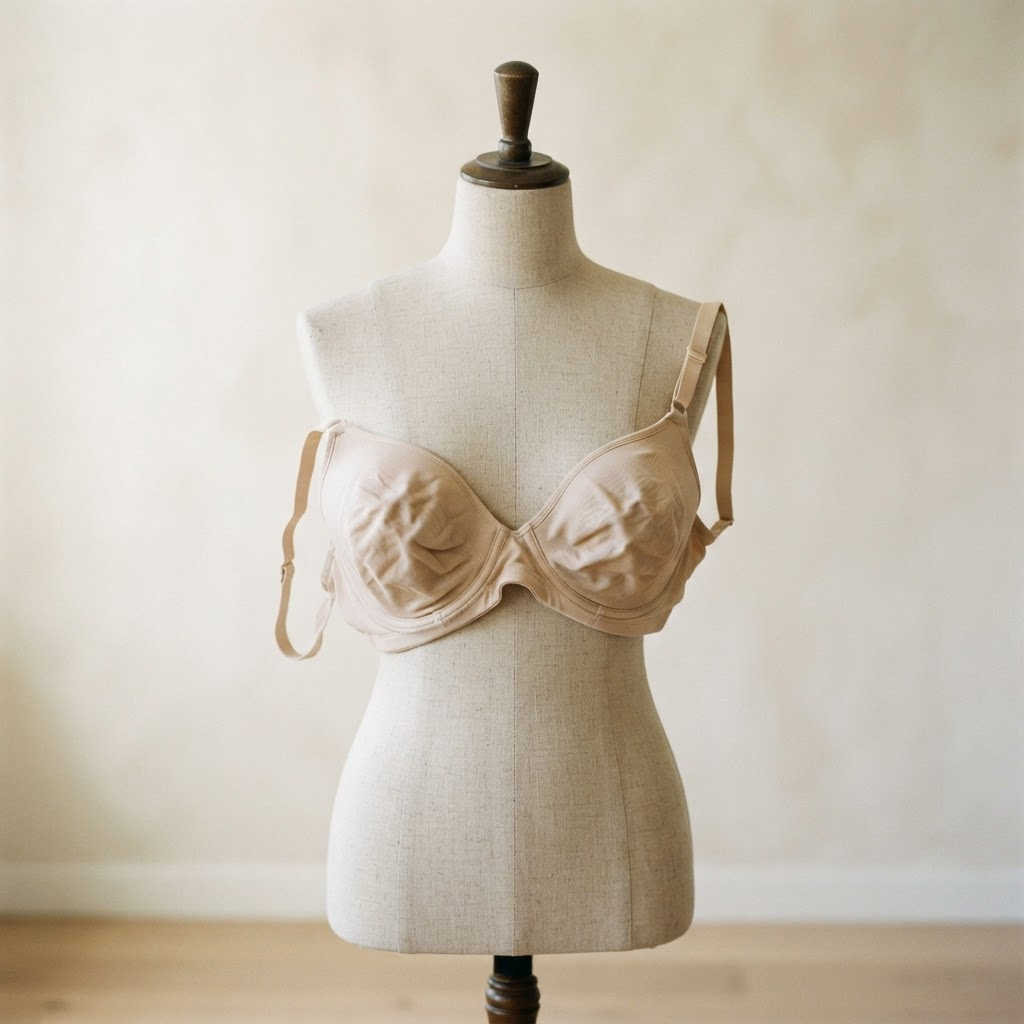
The same bra size looks completely different depending on where it's sold. Here's how US, UK, EU, and international sizing actually compare — and what to look for when a bra fits wrong in either direction.
Every sizing system starts from the same two numbers. Use a soft measuring tape, wear a thin unlined bra or none at all, and stand naturally — don't hold your breath or pull the tape tight.
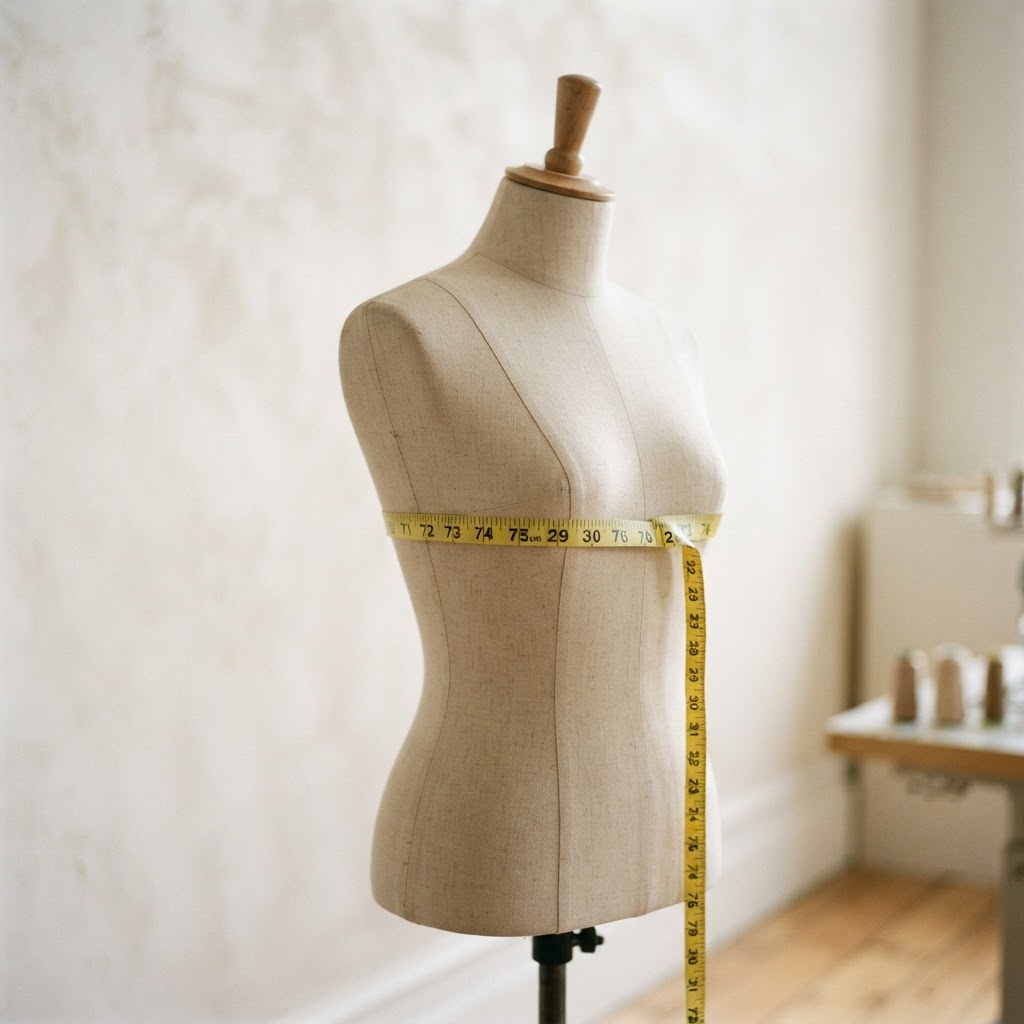
Wrap the tape around your ribcage directly under your bust, right where a bra band would sit. Keep it level and snug against the body without digging in. If the number lands on an odd inch, round up to the nearest even number.
Wrap the tape around your back and across the fullest part of your chest, over the apex. The tape should sit comfortably — not compressed, not loose.
Subtract your band measurement from your bust measurement. Each inch of difference corresponds to roughly one cup size, using the US letter sequence as the baseline.
| Difference | 0" | 1" | 2" | 3" | 4" | 5" | 6" | 7" | 8" |
|---|---|---|---|---|---|---|---|---|---|
| Cup | AA | A | B | C | D | DD / E | DDD / F | G | H |
A 34" bust and a 29" underbust is a 5" difference — that rounds to a 30 band (nearest even number) with a DD/E cup, so a 30DD or 30E depending on the brand's labeling.
Every system pairs a band number with a cup letter, but no two countries label them the same way. Bands run in inches in the US and UK, centimeters in the EU and Japan, an offset centimeter scale in France, and small whole numbers in Italy. Cup letters line up neatly through D — then every system splits off in its own direction.
| US / UK (in) | EU / Japan (cm) | France / Spain (cm) | Italy | Australia / NZ |
|---|---|---|---|---|
| 32 | 70 | 85 | 2 | 10 |
| 34 | 75 | 90 | 3 | 12 |
| 36 | 80 | 95 | 4 | 14 |
| 38 | 85 | 100 | 5 | 16 |
| 40 | 90 | 105 | 6 | 18 |
| US | UK | EU | France | AU / NZ | Japan | Italy |
|---|---|---|---|---|---|---|
| 32C | 32C | 70C | 85C | 10C | 70C | 2C |
| 34D | 34D | 75D | 90D | 12D | 75D | 3D |
| 36DD / E | 36DD | 80E | 95E | 14DD | 80E | 4E |
| 32G | 32F | 70G | 85G | 10F | 70G | 2G |
Below a D cup, the letters mostly agree — a US C and a UK C describe roughly the same volume. Above that, the UK inserts extra double letters (DD, FF, GG) that the US and most of Europe skip, so UK labels start to run "behind" the others. That last row is the clearest example: a UK 32F sits at roughly the same volume as a US 32G and a European 70G.
Conversion charts translate the label, not the fit. Wire width, cup depth, fabric stretch, and how a specific brand grades its pattern all shift the result. When ordering from a new country or brand, check that retailer's own size chart before converting by table alone.
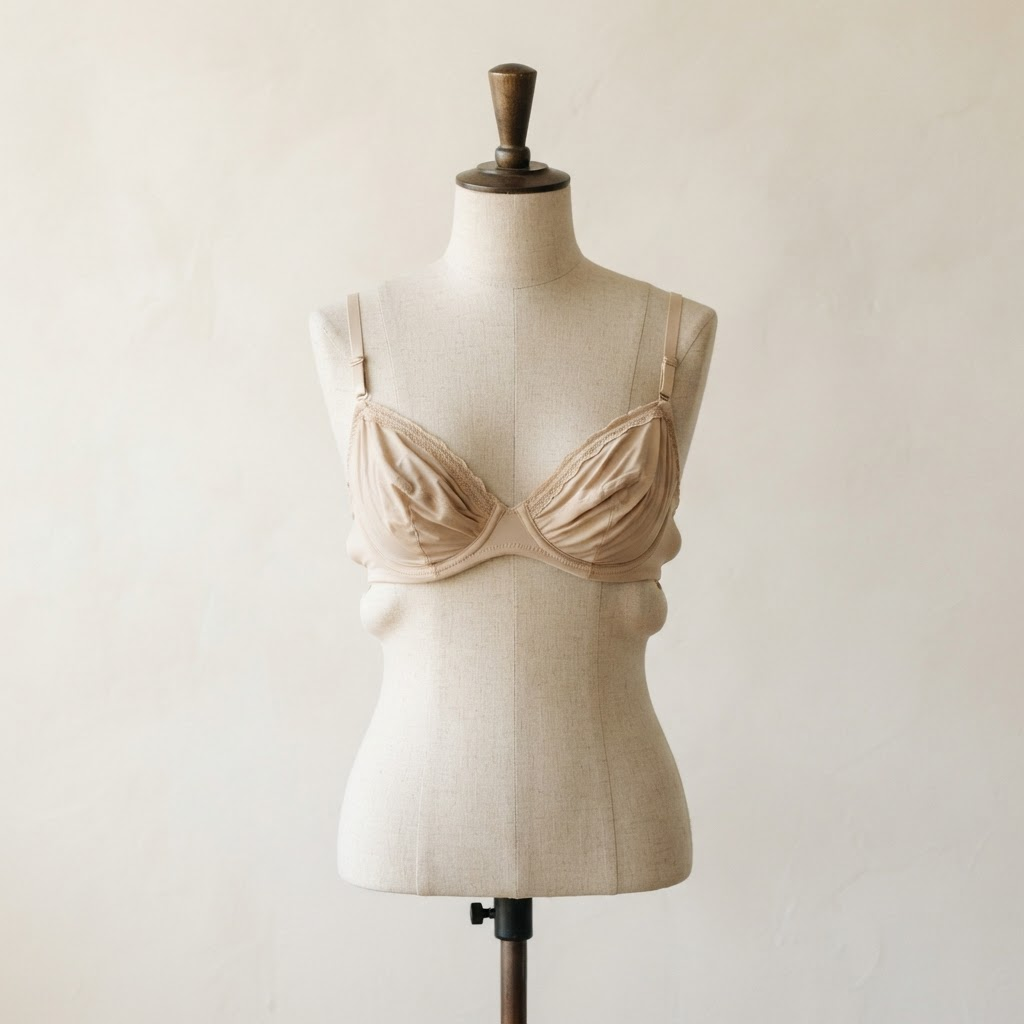
Label aside, these are the visual tells that a band or cup is off in either direction.